
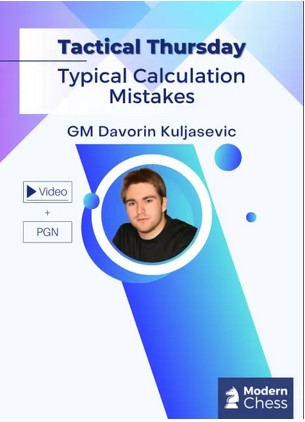
Tactical Thursday – Typical Calculation Mistakes + PGN GM Davorin Kuljasevic December 16, 2024
Original price was: $ 30.$ 4Current price is: $ 4.
OFF - 87%9998 in stock

Description
Reviews (0)
Description
| Category | Modern Chess, PREMIUM CHESS VIDEO |
|---|
The Tactical Thursday camp on Typical Calculation Mistakes is now available as a digital product, offering a comprehensive and practical guide to improving your ability to calculate variations. This product includes all the video lectures from the camp, along with a PGN file that complements the training sessions. In total, you’ll receive 6 hours of instructional video and a PGN database featuring 81 carefully selected files.
Let’s take a look at how GM Davorin Kuljasevic introduces the course:

White to move
We should start our calculation in every position with the prophylactic question: What would my opponent play if I gave him a free move? This step is often overlooked, but it’s crucial in understanding the position better. It helps us generate sensible candidate moves and avoid blunders.
In the ‘Ply Theory,’ we call this step ‘0 ply.’ It’s the preliminary step before you actually start calculating your first move (‘1 ply’), the opponent’s reply (‘2 ply’), and further moves (‘3 ply,’ ‘4 ply,’ etc.). Ply refers to half a move, as every full move consists of White’s and Black’s moves. This way, we ensure we pay proper attention to every step in the calculation process to reduce unnecessary calculation mistakes.
We start with 0 ply. You can simply ask yourself what Black would play if it were his move or play a random move like 21.h4 instead. When we do that, we realize that Black’s strongest threat is 21…Re5, with a discovered attack on the rook, not 21…Rxa2. This will help us in the next stage.
Next, we look at 1 ply, the candidate moves for White:
- 21.Qxa7 (capture, the most forcing move),
- 21.Rfe1 (escaping the discovered attack),
- 21.Rfd1 (same as 21.Rfe1).
Once we have our candidate moves, we start calculating lines, one by one, starting with 21.Qxa7.
We should pay particular attention to ply 2, the opponent’s resources. The best question to ask is: Can I refute my move? You should be skeptical about your candidate move, even if you really like it. This will allow you to find the opponent’s strong resources, such as 21…Re7 in the 21.Qxa7? line.
Reviews (0)
Leave a Reply
You also like

Chessbase Rock Solid with the Queen’s Indian Defence by Leon Mendonca
Original price was: $ 30.$ 4Current price is: $ 4. Quick ViewAdd to cart
Lifetime Repertoires The Nimzo-Ragozin – Sielecki Chessable
Original price was: $ 30.$ 4Current price is: $ 4. Quick ViewAdd to cart
A World Champion’s Repertoire against the Queen’s Gambit Declined by Robert Ris (MP4)
Original price was: $ 30.$ 4Current price is: $ 4. Quick ViewAdd to cart
Chessbase Key Concepts of Chess – Pawn Structures by Herman Grooten Volumes 1 and 2 This is...
Original price was: $ 30.$ 4Current price is: $ 4. Quick ViewAdd to cart
How to Find Positional Chess Sacrifices with IM Asaf Givon
Original price was: $ 30.$ 4Current price is: $ 4. Quick ViewAdd to cart
7Q Method – How to Find a Plan in Any Position By GM Avetik Grigoryan ( MP4 )
Original price was: $ 30.$ 4Current price is: $ 4. Quick ViewAdd to cart
Erwin’s Opening Lab : The Cozio Defense Chessable
Original price was: $ 30.$ 4Current price is: $ 4. Quick ViewAdd to cart
Queen’s Gambit Accepted – Simple Solution to 1.d4 by GM Grigor Grigorov, GM Petar G. Ar...
Original price was: $ 30.$ 4Current price is: $ 4. Quick ViewAdd to cart
Reviews
There are no reviews yet.