
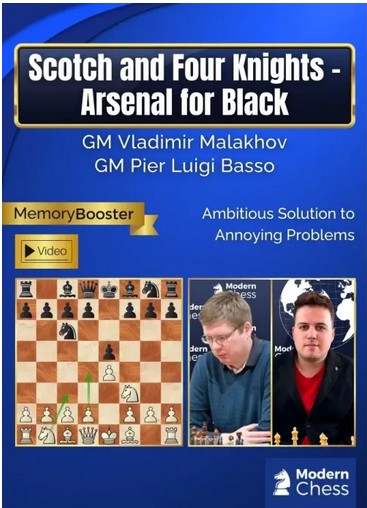
Scotch and Four Knights – Arsenal for Black January 12, 2026
Original price was: $ 30.$ 4Current price is: $ 4.
OFF - 87%10000 in stock

Description
Reviews (0)
Description
| Category | PREMIUM CHESS VIDEO, Modern Chess |
|---|
Scotch and Four Knights: The Ambitious Answer to White’s Most Direct Challenge
When GM Aronian Levon faced Kramnik’s 1.e4 e5 2.Nf3 Nc6 3.Nc3 Nf6 4.d4 exd4 5.Nxd4 in 2014, he responded with 5…Bc5—a move that signaled a shift in how elite players approach the Four Knights and Scotch complexes. Rather than accepting the sterile equality of 5…Bb4, Black chooses positions where genuine winning chances coexist with technical risks. This philosophy forms the backbone of GM Pier Luigi Basso and GM Vladimir Malakhov’s new course, where classical openings meet modern demands for dynamic counterplay.
Fighting Fire with Ambition
The Scotch and Four Knights present a unique challenge: White’s direct central action and concrete threats leave little room for passive defense. Traditional recommendations often lead to positions where Black must calculate accurately just to reach equality, with limited scope for independent play. Basso and Malakhov’s approach reverses this dynamic. Their recommended systems—centered on …Bc5 in both the Scotch (after 3.d4 exd4 4.Nxd4) and the Four Knights (after 4.d4 exd4 5.Nxd4)—transform these openings into battlegrounds where Black dictates the character of the position.
The course demonstrates how 4…Bc5 in the Scotch, combined with the sharp 5…Qf6 against 5.Be3, creates immediate tactical tension while maintaining long-term strategic resources. In the Four Knights, the Kramnik-Aronian precedent of 5…Bc5 receives fresh treatment through Erigaisi’s recent improvements, showing how modern preparation has refined what was once considered a risky experiment. The authors’ analysis reveals that these positions aren’t objectively superior to main lines—they’re superior for players who want to play chess rather than navigate forced sequences.
The Arsenal Philosophy: Comprehensive Solutions, Not Shortcuts
The Arsenal series represents a distinct approach to opening preparation: treating every White system—whether main line or sideline—as a serious challenge requiring specific, well-analyzed solutions. Rather than dismissing the Scotch Gambit (4.Bc4) or the positional 5.Nb3 as “less critical,” this course provides the same depth of coverage across all branches. The methodology combines deeply annotated model games with thematic structural examples, revealing typical tactical patterns and strategic blueprints that function over the board, not just in home preparation.
This approach, established in Basso and Malakhov’s previous collaborations on the French Defense – Arsenal and Semi-Slav Defense – Arsenal for Black, delivers something beyond theoretical knowledge: the ability to play these positions with genuine understanding. When you face 5.Nb3 or White’s attempts to sidestep theory with move-order subtleties at move 4 in the Four Knights (including the tricky 4.Bb5), you’ll recognize the resulting structures and know which plans work.
Complete Coverage from Elite Collaborators
Each major branch receives model game analysis, with particular attention to recent high-level encounters: Erigaisi-Grandelius and Chigaev-Fedorchuk illuminate Black’s resources in the sharp 5.Be3 Qf6 positions, while Jobava-Grandelius and Navara-Grandelius demonstrate how to handle the slower 5.Nb3 systems. The coverage extends to the forcing 5.Nxc6 Qf6 where White can choose between endgame simplification or maintaining tension, and the dynamic Scotch Gambit with 4.Bc4. Malakhov’s elite-level practical experience combines with Basso’s systematic treatment to ensure every variation receives the attention it demands.
Strategic Map of the Repertoire
Four Knights Complex (1.e4 e5 2.Nf3 Nc6 3.Nc3 Nf6)
- 4.d4 exd4 5.Nxd4 Bc5 — the Kramnik-Aronian structure with Erigaisi’s improvements
- 4.Bb5 and other move 4 sidelines — covered with concrete solutions
Scotch Game (1.e4 e5 2.Nf3 Nc6 3.d4 exd4)
- 4.Nxd4 Bc5 5.Be3 Qf6 — the main battlefield with sharp tactical play
- 5.Nb3 — positional treatment (Chapters 2-3, featuring the games of Grandelius)
- 5.Nxc6 Qf6 — forcing variation with endgame and middlegame options (Chapter 4)
- 4.Bc4 (Scotch Gambit) — entering the dynamic gambit lines (Chapter 9)
Technical Structure
- 11 Chapters
- 5 Thoroughly analyzed model games by GM Malakhov
- 20 test positions
- Memory Booster
Reviews (0)
Leave a Reply
You also like

Erwin’s Opening Lab : The Cozio Defense Chessable
Original price was: $ 30.$ 4Current price is: $ 4. Quick ViewAdd to cart
BIG Chessbase Magazine Collection From CBM 01 – 213 SDVL (PGN & CBH Collection) 25 GB SI...
Original price was: $ 30.$ 4Current price is: $ 4. Quick ViewAdd to cart
The Elegant English – Part 2 Chessable
Original price was: $ 30.$ 4Current price is: $ 4. Quick ViewAdd to cart
Must-Know Structures for 1.d4 Players – Part 1 by Mihail Marin
Original price was: $ 30.$ 4Current price is: $ 4. Quick ViewAdd to cart
Every Gambit Refuted Opening course by GM Eugene Perelshteyn Chessable
Original price was: $ 30.$ 4Current price is: $ 4. Quick ViewAdd to cart
Lifetime Repertoires The Nimzo-Ragozin – Sielecki Chessable
Original price was: $ 30.$ 4Current price is: $ 4. Quick ViewAdd to cart
Chessbase Rock Solid with the Queen’s Indian Defence by Leon Mendonca
Original price was: $ 30.$ 4Current price is: $ 4. Quick ViewAdd to cart
A Complete Najdorf Repertoire by IM Sopiko Guramishvili
Original price was: $ 30.$ 4Current price is: $ 4. Quick ViewAdd to cart
Reviews
There are no reviews yet.