
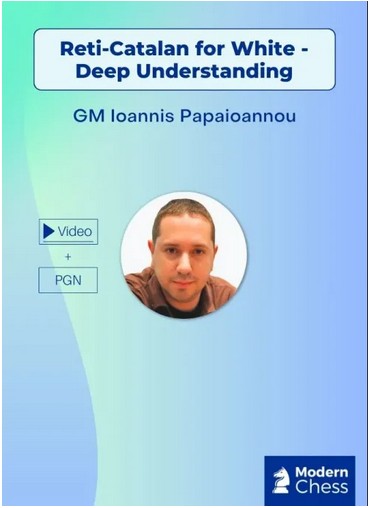
Reti-Catalan for White – Deep Understanding + PGN January 21, 2026
Original price was: $ 30.$ 4Current price is: $ 4.
OFF - 87%10000 in stock

Description
Reviews (0)
Description
| Category | PREMIUM CHESS VIDEO, Modern Chess |
|---|
Reti-Catalan for White – Deep Understanding
A strategic camp by Ioannis Papaioannou
The Reti–Catalan hybrid is one of the most flexible and conceptually rich systems in modern chess. Starting with
1.Nf3 Nf6 2.c4 e6 3.g3, White keeps maximum flexibility, avoids early theoretical commitments, and steers the game toward structures that reward deep positional understanding rather than memorization.
In Reti-Catalan for White – Deep Understanding, GM Ioannis Papaioannou presents a complete strategic framework for handling this system against all of Black’s major setups. This is not a repertoire based on forcing lines—it is a deep positional journey into how strong players actually think in Reti–Catalan structures.
Course Philosophy
The guiding idea of this camp is simple but powerful:
When you understand the typical structures, the opening variations take care of themselves.
Papaioannou focuses on:
structural themes rather than concrete move sequences,
typical plans for both sides,
and practical decision-making in positions that arise again and again in real games.
This approach makes the material durable, transferable, and highly practical.
Lesson 1 – 3…b6 and 3…c5
The starting point of the entire camp: 1.Nf3 Nf6 2.c4 e6 3.g3.
You will learn:
why delaying d2–d4 restricts Black’s options,
how to handle 3…b6 and smoothly transpose into favourable Queen’s Indian or Catalan-type positions,
why 3…c5 is considered inaccurate, and how White gains comfortable play with natural development.
The concept of useful waiting moves (such as Re1) is introduced here and becomes a recurring theme.
Lesson 2 – The 3…a6 Romanishin System
An ambitious and risky setup where Black aims for early queenside expansion with …b5.
This lesson explains:
how White should react energetically but calmly,
why fast development and central play are key,
and how typical minor-piece endgames favour White once the structure stabilises.
A practical guide to neutralising Black’s initiative and playing for a lasting edge.
Lesson 3 – 3…d5 4.Bg2 dxc4 (Part 1)
From this point onward, the camp moves to Black’s most principled response: 3…d5.
Key ideas:
why 4.Bg2 keeps the position flexible and avoids early forcing lines,
how Qa4+ is the most precise way to regain the pawn,
and how to evaluate Black’s different defensive setups.
This lesson lays the foundation for understanding the Open Catalan structures that follow.
Lesson 4 – 3…d5 4.Bg2 dxc4 (Part 2)
A deeper dive into the most critical continuation with …c6 and …b5.
You will study:
how White should fight against Black’s plan of …c5,
why moves like a4 are strategically essential,
and how development, not material, determines the evaluation.
This chapter is about timing and structural pressure, not tactics.
Lesson 5 – 3…d5 4.Bg2 d4
A topical and ambitious system where Black closes the centre early.
Papaioannou explains:
why 5.d3 is a subtle and flexible reply,
how White avoids drifting into inferior Benoni-type positions,
and how to build pressure step by step without overcommitting.
This lesson is an excellent example of positional finesse.
Lesson 6 – 3…d5 4.Bg2 Be7 (Part 1)
Here the course transitions into Catalan territory.
You will learn:
how and why White deliberately transposes into the Closed Catalan,
typical development schemes for both sides,
and how White prepares central expansion with minimal theoretical burden.
This lesson emphasizes harmony and long-term planning.
Lesson 7 – 3…d5 4.Bg2 Be7 (Part 2)
The final lesson focuses on the Open Catalan and related sidelines.
Key themes include:
optimal piece exchanges (especially bishop vs knight),
playing for slightly better endgames,
and recognising recurring strategic motifs such as h4–h5 ideas and queenside pressure.
The camp concludes by tying together Reti and Catalan structures into a single strategic system.
Reviews (0)
Leave a Reply
You also like

Erwin’s Opening Lab : The Cozio Defense Chessable
Original price was: $ 30.$ 4Current price is: $ 4. Quick ViewAdd to cart
7Q Method – How to Find a Plan in Any Position By GM Avetik Grigoryan ( MP4 )
Original price was: $ 30.$ 4Current price is: $ 4. Quick ViewAdd to cart
Lifetime Repertoires The Nimzo-Ragozin – Sielecki Chessable
Original price was: $ 30.$ 4Current price is: $ 4. Quick ViewAdd to cart
IM Christof Sielecki 33 Chess Concepts that took down World Champions (MP4)
Original price was: $ 30.$ 4Current price is: $ 4. Quick ViewAdd to cart
100 Repertoires: Four Knights Sicilian
Original price was: $ 30.$ 4Current price is: $ 4. Quick ViewAdd to cart
Chess Strategy and Tactics Mikhail Tal’s Amazing Games by Tryfon Gavriel (MP4)
Original price was: $ 30.$ 4Current price is: $ 4. Quick ViewAdd to cart
A World Champion’s Repertoire against the Queen’s Gambit Declined by Robert Ris (MP4)
Original price was: $ 30.$ 4Current price is: $ 4. Quick ViewAdd to cart
Chessbase Rock Solid with the Queen’s Indian Defence by Leon Mendonca
Original price was: $ 30.$ 4Current price is: $ 4. Quick ViewAdd to cart
Reviews
There are no reviews yet.