
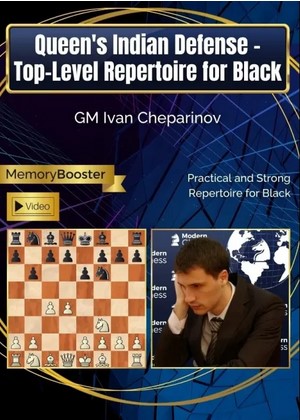
Queen’s Indian Defense – Top-Level Repertoire for Black August 15, 2025 + PGN
Original price was: $ 30.$ 4Current price is: $ 4.
OFF - 87%9997 in stock

Description
Reviews (0)
Description
| Category | Modern Chess, PREMIUM CHESS VIDEO |
|---|
Queen’s Indian Defense: GM Cheparinov’s Tournament-Ready Repertoire for Black
The Queen’s Indian Defense continues to attract elite players seeking a robust yet dynamic response to 1.d4. Modern Chess is proud to announce the release of “Queen’s Indian Defense – Top-Level Repertoire for Black” by GM Ivan Cheparinov, a comprehensive 4-hour and 53-minute course that combines practical tournament insights with rigorous theoretical analysis.
Why the Queen’s Indian Defense Matters in Modern Chess
After 1.d4 Nf6 2.c4 e6 3.Nf3 b6, Black immediately signals serious intentions.

This opening has been the weapon of choice for world champions and super-grandmasters who understand that sound positional play, when executed with precision, creates winning chances against any level of opposition.
GM Cheparinov’s approach emphasizes the practical tournament player’s perspective—a crucial element often missing from purely theoretical treatments. His repertoire choices prioritize positions where superior understanding and technique can outweigh computer-perfect preparation.
Strategic Foundation: Cheparinov’s Repertoire Philosophy
Against the Petrosian System: Immediate Central Tension
In the critical Petrosian System, Cheparinov advocates for 4.a3 Bb7 5.Nc3 d5 6.cxd5 Nxd5 7.Qc2 Nxc3 8.bxc3 c5 9.e4 Nd7.

This knight deployment represents a significant departure from conventional theory. While 9…Be7 enjoys broader theoretical coverage, Cheparinov’s 9…Nd7 creates immediate pressure along the c-file with the plan of …Rc8. In the resulting imbalanced pawn structure—where both sides possess distinct pawn majorities—the player with superior positional understanding consistently emerges with practical advantages.
Rehabilitating 4…Bb7: From Passive to Practical
Against the main line 1.d4 Nf6 2.c4 e6 3.Nf3 b6 4.g3, Cheparinov recommends 4…Bb7.

For decades, 4…Bb7 carried the stigma of passivity—solid but uninspiring. Cheparinov’s analysis reveals this assessment as fundamentally flawed. His course demonstrates concrete winning methods that prove this “modest” bishop move offers genuine practical winning chances while maintaining positional soundness.
Even in positions arising after 4…Bb7 5.Bg2 Be7 6.0-0 0-0 7.d5—traditionally considered annoying for Black—Cheparinov’s preparation neutralizes White’s initiative while preserving Black’s long-term strategic assets.
Advanced Strategic Choices: Risk and Reward
The f5 Advance: Calculated Aggression
In the position after 4…Bb7 5.Bg2 Be7 6.0-0 0-0 7.Nc3 Ne4 8.Bd2 f5, Cheparinov advocates for this double-edged advance.

As Cheparinov explains: “A riskier move in comparison to 8…d5, with the point that the bishop on b7 is still open and this move strengthens the control over the e4-square.” This choice exemplifies the practical tournament approach—accepting calculated risks to maintain dynamic potential.
After 1.d4 Nf6 2.c4 e6 3.Nf3 b6 4.g3 Bb7 5.Bg2 Be7 6.Nc3, Cheparinov advocates for the immediate 6…0-0.

This move order choice reflects Cheparinov’s commitment to creating winning chances. While 6…Ne4 represents the more common approach, Cheparinov’s 6…0-0 deliberately steers the game toward more imbalanced positions where Black retains genuine winning prospects.
The alternative 6…Ne4 transposes to positions arising after 6.0-0 0-0 7.Nc3 Ne4—lines that Cheparinov also covers comprehensively. However, the immediate castling maintains additional strategic flexibility while avoiding certain simplified variations that may limit Black’s winning potential.
The Waiting Move Concept: 7…h6!?
Perhaps the most innovative aspect of Cheparinov’s repertoire appears after 4…Bb7 5.Bg2 Be7 6.0-0 0-0 7.Re1 h6!?

This rare move, endorsed by modern engines, represents sophisticated strategic thinking. While more complex than established main lines, 7…h6!? functions as a productive waiting move. The key point: if White plays Nc3, Black immediately seizes the initiative with …Ne4, exploiting the knight’s optimal central placement.
Complementary Learning: The Grigorov Connection
GM Cheparinov’s course forms an ideal pairing with GM Grigor Grigorov’s “Understand the Queen’s Indian Defence”. While both grandmasters recommend similar repertoire choices and cover identical theoretical lines, their approaches complement each other perfectly.
Grigorov’s 6-hour course provides comprehensive coverage of essential pawn structures and middlegame patterns that every Queen’s Indian Defense practitioner must master. Combined with Cheparinov’s tournament-focused analysis, these courses offer complete preparation for serious competitive play.
Course Structure and Learning Components
Cheparinov’s course delivers practical learning through multiple formats:
- 19 Theoretical Chapters: Complete coverage of all major systems and sidelines
- 20 Interactive Test Positions: Sharpen tactical awareness and pattern recognition
- Memory Booster: Reinforce key theoretical knowledge efficiently
- Video Version: 4 hours and 53 minutes of detailed explanation and analysis
Reviews (0)
Leave a Reply
You also like

Chessbase Key Concepts of Chess – Pawn Structures by Herman Grooten Volumes 1 and 2 This is...
Original price was: $ 30.$ 4Current price is: $ 4. Quick ViewAdd to cart
Chessbase Play the Pirc like a Grandmaster Vol. 1: Positional lines CBFT
Original price was: $ 30.$ 4Current price is: $ 4. Quick ViewAdd to cart
BIG Chessbase Magazine Collection From CBM 01 – 213 SDVL (PGN & CBH Collection) 25 GB SI...
Original price was: $ 30.$ 4Current price is: $ 4. Quick ViewAdd to cart
Pawns on One Wing in the Endgame, GM Ioannis Papaioannou
Original price was: $ 30.$ 4Current price is: $ 4. Quick ViewAdd to cart
100 Repertoires: Four Knights Sicilian
Original price was: $ 30.$ 4Current price is: $ 4. Quick ViewAdd to cart
How To Win With Zugzwang by GM Dejan Bojkov (Chesscom Lessons) ( MP4 + PGN )
Original price was: $ 30.$ 4Current price is: $ 4. Quick ViewAdd to cart
A World Champion’s Repertoire against the Queen’s Gambit Declined by Robert Ris (MP4)
Original price was: $ 30.$ 4Current price is: $ 4. Quick ViewAdd to cart
The modern Grand Prix Attack – Trent SDVL & PGN
Original price was: $ 30.$ 4Current price is: $ 4. Quick ViewAdd to cart
Reviews
There are no reviews yet.