
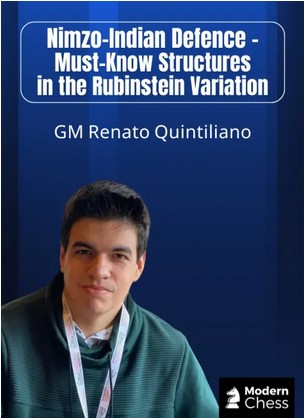
Nimzo-Indian Defense – Must-Know Structures in the Rubinstein Variation + PGN June 28, 2025
Original price was: $ 30.$ 4Current price is: $ 4.
OFF - 87%9999 in stock

Description
Reviews (0)
Description
| Category | Modern Chess, PREMIUM CHESS VIDEO |
|---|
We are excited to present the brand-new follow-up course by GM Renato Quintiliano, complementing his acclaimed repertoire “Nimzo-Indian Defence for White – Rubinstein Variation”. This time, Quintiliano dives deep into the positional backbone of the Rubinstein system by exploring 6 must-know pawn structures that every Nimzo-Indian player should master.
This course is not about memorizing moves – it’s about understanding chess.
♟️ Course Structure:
Each chapter is centered around a typical pawn structure. You will find:
✅ General introduction to the structure with all major strategic ideas
✅ 2 deeply annotated model games that show the structure in action
✅ 1 practical test exercise with a detailed solution to test your understanding
🔍 The 6 Must-Know Structures:
Structure 1

This represents the most iconic structure in the Nimzo-Indian Defense, arising when the dark-squared bishop exchanges for White’s knight on c3, creating a fundamental imbalance: White’s bishop pair and central space advantage versus Black’s potential exploitation of the doubled c-pawns.
Black typically responds with the central barrier c5-d6-e5 to compensate for the missing dark-squared bishop, then targets the c4-pawn through maneuvers like Nc6-a5 and Ba6. In closed positions, Black’s knights become more valuable than White’s bishop pair.
White’s success depends entirely on maintaining structural flexibility to enable critical pawn breaks (e3-e4-e5, f2-f3, or f2-f4) and dynamic play, often including the thematic c4-pawn sacrifice for kingside attacking chances. Understanding the precise timing of these advances separates strong players from experts.
The subtle advantage of keeping the a-pawn on a2 gives White a crucial tempo over the Saemisch Variation while preventing Black’s exploitation of the b3-square weakness.
Structure 2

This is a very classic structure in which White has an isolated pawn on d4. The plans for both sides are widely known for any experienced player: White should either play for the initiative and look for attacking ideas on the kingside, or prepare the advance d4-d5 to eliminate the isolated pawn and gain active central play. Black aims to prevent these ideas and exploit the pawn as a strategic weakness in the endgame.
However, the knight on e2 gives a modern touch to this position and adds several interesting tactical possibilities. A key detail is that it can relocate to either c3 or f4, supporting the crucial d4-d5 advance or increasing pressure on the kingside. This flexibility makes it significantly harder for Black to maintain control over the critical blockading square d5.
Another important advantage is that White has the third rank free to maneuver the queen to the important h3-square, from where it monitors many critical points on Black’s kingside and creates multiple threats.
The strategic drawback is obviously the more passive position of the knight, so White must play actively to prevent Black from consolidating and exploiting this positional concession in the long term.
Structure 3

This structure arises when Black recaptures with the e6-pawn on d5, creating a solid and symmetric game. In symmetric structures, the advantage goes to whoever seizes the initiative first.
White’s extra tempo from the initial move allows for slightly more active piece development, increasing chances of achieving the initiative faster. The key is to exploit the lead in development by placing rooks on the open files.
Once again, the Ne2 plays a crucial role, offering flexibility to pressure d5 from either c3 or f4. In some cases, Ng3-f5 can create kingside threats and capitalize on White’s superior piece coordination.
Structure 4

This is another typical Nimzo structure with opposite flank play. White has a central majority, making the natural plan f2-f3 and e3-e4 expansion. Success not only gains significant central space but also activates the dark-squared bishop powerfully.
Black should mobilize all forces in the center to prevent this plan, often using the typical h5-h4 idea to disturb the Ng3 and disrupt White’s coordination.
Alternatively, Black can develop queenside counterplay by advancing the majority or maneuvering the knight to c4 via a5. However, this releases central pressure, often allowing White to execute the central advance and develop a strong kingside attack.
Structure 5

This is a very common structure arising from multiple openings like the Queen’s Indian, Semi-Tarrasch, Grünfeld, and Nimzo-Indian. White’s central majority provides a small space advantage and potential for a central passed pawn.
Black has a queenside majority, but it’s difficult to exploit. The typical a4-a5 advance can open the a-file but often leaves Black with an isolated queenside pawn.
An important detail in Nimzo positions is the dark-squared bishop on f4, which controls key enemy squares and makes Black’s coordination significantly harder.
The Ne2 might be strategically problematic in some cases, but if Black releases d4 tension, it easily improves to the more active c3-square.
Structure 6

This structure is naturally complex and tense. White has seriously weakened the light squares (despite the bishop on d3) to seize more central space. Black’s obvious plan is to exploit these weaknesses by exchanging light-squared bishops or controlling key squares like c4 or e4.
White must seek dynamic play to succeed. Typical plans include a timely e4-e5 advance followed by strong kingside attacks. The f4-f5 advance can also be considered, opening the f-file and securing the center.
Ng3-h5 is another key idea to weaken the enemy king by exchanging an important kingside defender.
A crucial detail: White doesn’t need to hurry since Black struggles to increase central tension and force strategic concessions.
Whether you’ve already studied the Rubinstein repertoire or you’re looking to deepen your strategic feel in queen’s pawn openings, this course will take your understanding to the next level. By mastering these structures, you’ll not only improve in the Nimzo – you’ll become a stronger positional player overall.
Reviews (0)
Leave a Reply
You also like

Killer Instinct Conversion in the Endgame
Original price was: $ 30.$ 4Current price is: $ 4. Quick ViewAdd to cart
7Q Method – How to Find a Plan in Any Position By GM Avetik Grigoryan ( MP4 )
Original price was: $ 30.$ 4Current price is: $ 4. Quick ViewAdd to cart
7 The Paco Vallejo Method – GM Paco Vallejo
Original price was: $ 30.$ 4Current price is: $ 4. Quick ViewAdd to cart
Pawns on One Wing in the Endgame, GM Ioannis Papaioannou
Original price was: $ 30.$ 4Current price is: $ 4. Quick ViewAdd to cart
Chessbase Key Concepts of Chess – Pawn Structures by Herman Grooten Volumes 1 and 2 This is...
Original price was: $ 30.$ 4Current price is: $ 4. Quick ViewAdd to cart
How To Win With Zugzwang by GM Dejan Bojkov (Chesscom Lessons) ( MP4 + PGN )
Original price was: $ 30.$ 4Current price is: $ 4. Quick ViewAdd to cart
How to Find Positional Chess Sacrifices with IM Asaf Givon
Original price was: $ 30.$ 4Current price is: $ 4. Quick ViewAdd to cart
Calculation Workshop with FM Viktor Neustroev (MP4)
Original price was: $ 30.$ 4Current price is: $ 4. Quick ViewAdd to cart
Reviews
There are no reviews yet.