
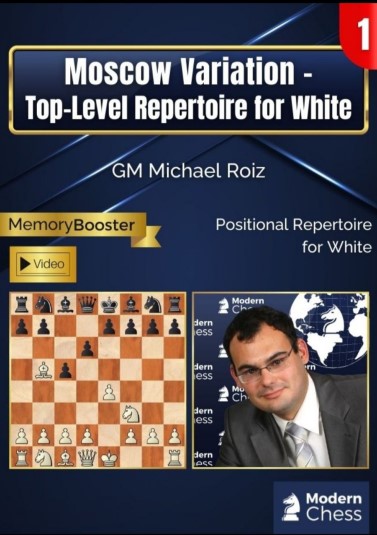
Moscow Variation Top -Level Repertoire For White Part 1
Original price was: $ 30.$ 4Current price is: $ 4.
OFF - 87%We are happy to announce another fascinating project by GM Michael Roiz – Moscow Variation against the Sicilian Defence.
The starting position of the repertoire arises after 1.e4 c5 2.Nf3 d6 3.Bb5+
99999 in stock

Description
Reviews (6)
Description

The project consists of 2 courses. The current one deals with 3…Bd7 which is the most popular continuation. The second database will be dedicated to the very topical 3…Nd7. The move 3…Nc6 will be examined in the series about Rossolimo that GM Roiz is going to produce soon.
The repertoire in the first database is based on 3…Bd7 4.c4

This is only the third most popular option. After an eventual exchange on b5, the white b5-pawn not only takes space on the queenside, but also prevents Black from the developing the knight on an active square. You can play this line without having to remember a lot of theoretical lines. Additionally, it’s quite likely that your opponent will not be sufficiently prepared against this system.
The course consists of 14 theoretical chapters, 14 interactive test positions, a Memory Booster, and a Video Version (2h and 17min Running Time).
In Chapters 1-2, GM Roiz examines the position arising after 4…Bxb5 5.cxb5

As mentioned earlier, the b5-pawn is an important asset for White. We are now ready to continue with Nc3 followed by d2-d4. According to the analysis, White can rely on a small advantage in this line.
The main tabiya of Chapter 3 is being reached after 4…a6 5.Bxd7 Qxd7 6.Nc3 Nc6 7.0-0

White is ready to follow with d2-d4, thus entering a typical Maroczy Bind. It turns out that the move …a7-a6 (weakening the b6-square) is often in White’s favour. Another interesting point is that the immediate 7…g6 is very well met by 8.b4 which is a novelty!
Chapter 4 is dedicated to the position arising after 4…a6 5.Bxd7 Nxd7 6.Nc3 Ngf6 7.0-0

Now, Black faces a choice. He can develop the dark-squared bishop either via e7 or g7. In both cases, Roiz goes for a setup based on d2-d3.
Chapter 5 features the position arising after 4.c4 e5

Black radically prevents d2-d4, but it costs him weakening d5. Also, the f8-bishop is somewhat problematic from now on. In this structure, White usually goes for a queenside play based on b2-b4.
Chapter 6 examines a slightly different version of the same structure. The starting position of this chapter is being reached after 4…Nc6 5.Nc3 e5

This is Black’s 3rd choice. It leads to a very closed position, when both sides struggle to make progress on any side of the board. Even so, White benefits from having somewhat more active pieces. Note that if Black chooses a setup based on Nge7, a very typical idea is h2-h4 which is a prophylaxis against …Ng6.
Chapter 7 examines the line 4…Nc6 5.Nc3 g6

A flexible continuation. Black opts for an early fiachetto in order to take more control of d4. White’s most promising direction is 6.Bxc6 followed by d2-d4. Analysis shows that White can fight for a slight advantage in this line.
Chapters 8–9 examine the position arising after 4…Nc6 5.Nc3 Nf6 6.0-0

In this position, Black’s main continuation is 6…g6. All the alternatives are examined in Chapter 8.
After 6…g6, White should go for a Maroczy Bind by means of 7.Bxc6 Bxc6 8.d4. We can definitely rely on a slight edge in this line.
Chapter 10 examines the position arising after 4…Nf6 5.Nc3 g6 6.Bxd7 Nxd7

This position is often reached with 4.Bxd7+ Nxd7,e.t.c. Similarly to 4…a6 5.Bxd7+ Nxd7 Roiz prefers to deviate from immediate confrontation in centre and keep the position closed. Therefore, he advocates a setup based on d2-d3. The arising positions are practically very annoying for Black.
A very important position for our repertoire is being reached after the moves 4…Nf6 5.Nc3 g6 6.Bxd7 Qxd7 7.d4 cxd4 8.Qxd4

Since 8.Nxd4 often leads to exchnage of knights, I find this recapture sensible: Since White has a traditional space advantage, it makes sense to deviate from simplifications.
This tabiya is examined in Chapters 11-12.
Chapter 13 deals with the position arising after 4…Nf6 5.Nc3 e6 6.0-0 Be7

In this position, White’s most precise reaction is 7.Bxd7+. Depending on the way Black decides to recapture, White will follow with either d2-d4 or d2-d3.
The last Chapter 14 examines the line 4…g6 5.Bxd7 Qxd7 6.d4 Bg7

In this position, White can fight for an advantage by means of 7.d5!, entering a Benoni structure. White has every chance to outplay his opponent in the arising complex positions.
Reviews (6)
6 reviews for Moscow Variation Top -Level Repertoire For White Part 1
Leave a Reply
You also like

C80-81 Korchnoi Sahovsky Informator
Original price was: $ 30.$ 4Current price is: $ 4. Quick ViewAdd to cart
Beating the Najdorf Rare Lines By Ranko Szuhanek Chess Informant 2021 (PDF + Pgn )
Original price was: $ 30.$ 4Current price is: $ 4. Quick ViewAdd to cart
Chess Database | Chessbase CBM 219 Extra
Original price was: $ 30.$ 4Current price is: $ 4. Quick ViewAdd to cart
How to Find Positional Chess Sacrifices with IM Asaf Givon
Original price was: $ 30.$ 4Current price is: $ 4. Quick ViewAdd to cart
CHESS APPS PORTABLE OFFLINE CHESS PUZZLE 3.700.000 LICHESS DATABASE PUZZLE INCLUDE
Original price was: $ 100.$ 4Current price is: $ 4. Quick ViewAdd to cart
CHESS DATABASE | 3600 Annotated Games by Gary Kasparov
Original price was: $ 30.$ 4Current price is: $ 4. Quick ViewAdd to cart
Killer Instinct Conversion in the Endgame
Original price was: $ 30.$ 4Current price is: $ 4. Quick ViewAdd to cart
The Elegant English – Part 2 Chessable
Original price was: $ 30.$ 4Current price is: $ 4. Quick ViewAdd to cart
Ryder (verified owner) –
The ideas taught in this course helped me defend against a brutal attack in my last tournament. I was able to secure the half-point once I defused the attack.
Phoenix (verified owner) –
I’ve only reviewed all the black lines but I am liking the author’s approach of adding exercises after each chapter to make sure you are looking at the positions themselves rather than just routinely memorizing the lines without absorbing the content of his commentary.
Aiden (verified owner) –
Now that I don’t need to invest much energy in the opening phase, I can concentrate on improving my middle and endgame play.
John (verified owner) –
In two recent wins, my opponents failed to follow the golden rules, making it easy for me to win the games.
Chelsi (verified owner) –
I bought this course with video few weeks ago (thanks to @JRHat for recommending it to me).
Riley (verified owner) –
Even when one of my opponents didn’t follow theory, which often happens with beginners,