
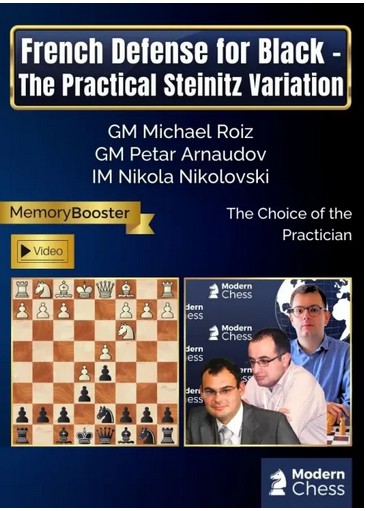
French Defense for Black – The Practical Steinitz Variation + PGN February 8, 2026
Original price was: $ 30.$ 4Current price is: $ 4.
OFF - 87%10000 in stock

Description
Reviews (0)
Description
| Category | PREMIUM CHESS VIDEO, Modern Chess |
|---|
French Defense for Black – The Practical Steinitz Variation
The Steinitz Variation occupies a fascinating niche in the French Defense landscape. While classical French players navigate the complex tactical waters of the Winawer (3…Bb4), the Steinitz presents a fundamentally different strategic proposition: Black accepts the advanced e5-pawn and prepares systematic counterplay against White’s center. This course by GM Petar Arnaudov, GM Michael Roiz, and IM Nikola Nikolovski examines the Steinitz through a practical lens—not as a passive defensive system, but as a serious repertoire weapon built on understanding typical structures rather than memorizing endless variations.
A Strategic Alternative to Main Line Theory
The course addresses a common dilemma for French Defense players: how to maintain your opening style while avoiding the most heavily analyzed positions. After 1.e4 e6 2.d4 d5 3.Nc3 Nf6 4.e5 Nfd7, Black commits to a clear strategic framework—the advanced e5-pawn becomes both White’s space advantage and a potential target. The Steinitz sidesteps the forcing nature of the Winawer’s tactical complications while offering rich strategic play based on piece placement, pawn breaks with …c5 and …f6, and concrete understanding of typical middlegame plans.
GM Roiz, who previously authored French Defense for Black – Play the Steinitz Variation, brings his deep understanding of French structures to this expanded treatment. The collaboration with GM Arnaudov, and IM Nikolovski—whose work on The Chess Thinking Process – Static Factors and Planning emphasizes practical decision-making and positional evaluation—ensures the material balances theoretical precision with applicable strategic understanding. The course’s approach mirrors this philosophy: rather than drowning you in computer lines, it develops your ability to recognize critical moments and make informed decisions based on structural factors.
Variation Map
The course systematically covers White’s main tries after 1.e4 e6 2.d4 d5 3.Nc3 Nf6 4.e5 Nfd7:
After 5. Nce2 c5 6. c3 Nc6 7. Nf3 cxd4 8.cxd4 f6 9. exf6 Nxf6:
(Chapter 1) 5.Nce2 – Without 10.Nc3 – White develops the knight to e2, maintaining flexibility
(Chapter 2) 5.Nce2 – With 10.Nc3 – The critical main line with 10.Nc3 reinforcing the center
After 5. f4 c5 6. Nf3 Nc6 7. Be3 cxd4 8. Nxd4 Bc5 9. Qd2 a6:
(Chapter 3) 5.f4 – 9.Qd2 a6 10.g3 – Fianchetto setup
(Chapter 4) 5.f4 – 9.Qd2 a6 10.Be2 – Classical development prioritizing rapid castling
(Chapter 5) 5.f4 – 9.Qd2 a6 10.h4 – Aggressive kingside pawn storm
(Chapter 6) 5.f4 – 9.Qd2 a6 10.a3 – Prophylactic play preparing queenside expansion
(Chapter 7) 10.0-0-0 – Nxd4 Minor Lines – Early piece exchanges after queenside castling
(Chapter 8) 10.0-0-0 – 12.Qxd4 Qb6 13.Ne2 – White tries to maintain control over d4
(Chapter 9) 10.0-0-0 – 12.Qxd4 Qb6 13.Qd2 – Queen retreat variations avoiding simplifications
(Chapter 10) 10.0-0-0 – 12.Qxd4 Qb6 13.Qxb6 – Queen trade leading to technical endgames
(Bonus Chapter 11) 5.Nce2 c5 6.c3 Nc6 7.a3 – Rare system from White
(Bonus Chapter 12) 4.e5 Nfd7 – Minor Lines – Early deviations and sidelines
(Bonus Chapter 13) 4.e5 Nfd7 5.Nf3 c5 6.dxc5 – Early exchange on c5
(Bonus Chapter 14) 5.f4 c5 6.dxc5 – Accepting Black’s central break immediately
(Bonus Chapter 15) 7.Ne2 Be7 8.c3 – Restrained setup avoiding early commitments
Reviews (0)
Leave a Reply
You also like

ChessBase Magazine #214 Full Version & SDVL
Original price was: $ 30.$ 4Current price is: $ 4. Quick ViewAdd to cart
Killer Instinct Conversion in the Endgame
Original price was: $ 30.$ 4Current price is: $ 4. Quick ViewAdd to cart
IM Christof Sielecki 33 Chess Concepts that took down World Champions (MP4)
Original price was: $ 30.$ 4Current price is: $ 4. Quick ViewAdd to cart
Lifetime Repertoires The Nimzo-Ragozin – Sielecki Chessable
Original price was: $ 30.$ 4Current price is: $ 4. Quick ViewAdd to cart
3 The Lenderman Method 1 – GM Aleksandr Lenderman
Original price was: $ 30.$ 4Current price is: $ 4. Quick ViewAdd to cart
Every Gambit Refuted Opening course by GM Eugene Perelshteyn Chessable
Original price was: $ 30.$ 4Current price is: $ 4. Quick ViewAdd to cart
The Elegant English – Part 2 Chessable
Original price was: $ 30.$ 4Current price is: $ 4. Quick ViewAdd to cart
30 Fundamental Classical Games with GM Renato Quintillano
Original price was: $ 30.$ 4Current price is: $ 4. Quick ViewAdd to cart
Reviews
There are no reviews yet.