
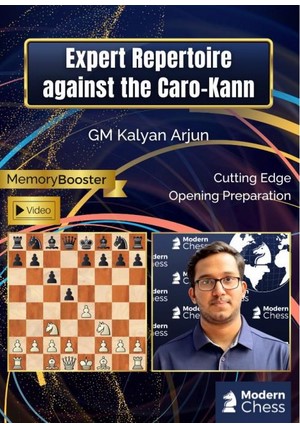
Expert Repertoire against the Caro-Kann + PGN GM Kalyan Arjun July 19, 2023
Original price was: $ 30.$ 4Current price is: $ 4.
OFF - 87%10000 in stock

Description
Reviews (0)
Description
| Category | Modern Chess, PREMIUM CHESS VIDEO |
|---|
After his highly successful course Expert Repertoire against the French Defence, GM Kalyan Arjun launches another in-depth opening survey – Expert Repertoire against the Caro-Kan.
The suggested repertoire is based on the Two Knights Variation arising after 1.e4 c6 2.Nf3 d5 3.Nc3

The suggested repertoire is both solid and ambitious. Combining his understanding with the help of the modern engines, GM Arjun demostrates how White can put pressure in all the slightly more pleasant positions that typically arise in this line.
The course consists of 9 theoretical chapters, 20 interactive test positions, a Memory Booster, and a Video Version (3h+ Running Time).
Preview by the Author
The Caro-Kann is rapidly gaining popularity and is one of the most trendy openings right now. It is particularly attractive because it can be played against both higher and lower-rated players – there are not too many forcing lines. It is quite positional in nature.
My suggestion is 1.e4 c6 2.Nf3 d5 3.Nc3

This is the Two Knights Attack. We develop our knights first before pushing the ‘d’ pawn. Our development is very flexible and there are many cases where we go for the move d3. This has become popular over the last few years with many top players employing it in their repertoire.
Black is at crossroads now. Let’s start with the relatively less popular 3…g6. This is a combination of the Caro-Kann and Modern/Pirc lines. Black allows us to get full control over the centre and is hoping to outplay us positionally. We cover this and a few other sidelines in Chapter 1.
My suggestion against this system is 4.d4 Bg7 5.h3

Now we stop the move Bg4 and secure our kingside. Many years ago I attended a camp where we discussed some of the sidelines for Black such as the Alekhine and Scandinavian. I realised that one of the major problems that Black faces in these structures is the bishop on c8. It lacks a good square along the c8-h3 diagonal. That is the reason why Black sometimes plays Bg4 and takes on f3 to trade it off. We do not allow that.
Another interesting interesting idea is 3…Nf6

Black is forcing us to clarify the tension in the centre. We will cover this in Chapter 2. The main line goes 4.e5 Ne4 5.Ne2 – Not on his terms! The immediate idea is to play d3 and kick the knight out. The other plan is to take the knight to g3 and then force Black to open the ‘h’ or ‘f’ file for our rook.
The move 3…Bg4 is the most popular move in the position and is very principled.

Black fights back in the centre and does not allow us to gain full control over the centre. It leads to more complex positions compared to 3…dxe4 and we will welcome that. We will devote Chapters 3-5 to this variation.
The main line is 4.h3 Bxf3 5.Qxf3 e6 (5…Nf6 is examined as well) 6.Be2

This is the third most played move in the position but it is very topical these days. I always believe that when we have a choice we should go for the most necessary move to remain very flexible. We want to castle kingside first. White does not intend to go d4 unless Black goes for either Nd7 or Bc5. We will see how Black develops his pieces.
Black’s main move is 6…Nf6 This is the most common move in the position. The knight is directly fighting for control over the centre.
In case of 6…Nd7 Black blocks his queen thus allowing us to get control over the centre with 7.d4. The advance 6…d4 is possible on several different moves. I like this structure for us as our plans are very simple. We will go Nb1, d3, Nd2 followed by either h4, Qh3 or g3, Qg2 and f4. 6…Bc5 is the 3rd most popular move in the position but it was recommended by Erwin l’Ami in his course on the Caro-Kann. It has since become quite popular and I have faced it in numerous games both online and OTB. What is the point? Black will next develop his knight to e7 and not allow us to get d4 easily. This is the subject of the Chapter 4. My suggestion against 6…Bc5 is 7.Qg3 This has been played in less than 10% of the games but I think that it is the most dangerous weapon against Black’s system. I will give you two different alternatives here. I believe that both of them pose a lot of practical problems for Black.
Let’s get back to the main move 6…Nf6. White plays 7.0-0 when Black is at crossroads.

Black can try a variety of ideas here. The most obvious ones are 7…Bc5, 7…Nbd7, 7…Be7, and 7…d4. In Chapter 5, I will demonstrate how you can create practical problems against each one of these moves.
Objectively speaking, however, probably the best continuation for Black is 3…dxe4. Nowadays this is the most common response from Black across all levels. It is not a big surprise since it is the easiest to play as Black and he does have a lot of options here. Most people go for similar lines against the 3.d4 system (Nf6 lines).
My suggestion is 4.Nxe4 Nf6 5.Qe2!

This may come as a surprise to a few people. We do not want to take on f6 and free up Black’s development. We want to force Black to help us bring our queen out to the centre. This contradicts one of the general principles-do not bring your queen out too early. However, with all of the other black pieces still in the back rank, he cannot exploit it. We will cover this in Chapters 6-9. The first 2 chapters will cover all of the different sidelines in great detail.
The main crossroads arise after 5…Nxe4 (I also cover 5…Na6 and 5…Bf5) 6.Qxe4

Black has a number of options here:
6…Be6 is a strange move but Black wants to get his bishop to d5 before finishing his development. Also, he wants to get Nd7 without blocking the bishop. I recommend a relatively fresh idea in this direction.
6…Qa5 is the third most popular move in the position. What is the point of this move? Black wants to go either Bf5 or Qf5 and harass our queen. He also copies us in bringing the queen out early. My idea here is 7.b4!. Now we are the ones harassing our opponent’s queen. We gain useful space on the queenside and also the b2 square for the bishop.
6…Nd7 is the most popular move in the position. Earlier I used to believe that Qd5 was the critical move and this gives White very comfortable play after Bc4, Ne5. However, after some new developments, it is not easy at all to pose any problems there. On the flip side for Black the lines with d4 are pretty one-sided with only White having chances to push. It is relatively risk-free. My main line goes 7.d4 Nf6 Now there are several options to choose from. I will recommend two different options. Both of them give us a pleasant position without much risk. I feel here it is more important to understand the typical ideas and play some training games rather than concrete preparation. I will highlight some of the typical ideas and plans for the position.
6…Qd5 In my mind this was always the main line in the 3…dxe4 variation but I think its popularity has come down slightly over the last few years. Black chases our queen around to exchange it. We have two major options- Qf4 and Qh4. I have analysed both of them pretty deeply. I mostly played Qh4 and I will have it as my main line. It is safer while Qf4 usually involves a pawn sacrifice.
Reviews (0)
Leave a Reply
You also like

7 The Paco Vallejo Method – GM Paco Vallejo
Original price was: $ 30.$ 4Current price is: $ 4. Quick ViewAdd to cart
BIG Chessbase Magazine Collection From CBM 01 – 213 SDVL (PGN & CBH Collection) 25 GB SI...
Original price was: $ 30.$ 4Current price is: $ 4. Quick ViewAdd to cart
Chessbase Key Concepts of Chess – Pawn Structures by Herman Grooten Volumes 1 and 2 This is...
Original price was: $ 30.$ 4Current price is: $ 4. Quick ViewAdd to cart
Calculation Workshop with FM Viktor Neustroev (MP4)
Original price was: $ 30.$ 4Current price is: $ 4. Quick ViewAdd to cart
Pawns on One Wing in the Endgame, GM Ioannis Papaioannou
Original price was: $ 30.$ 4Current price is: $ 4. Quick ViewAdd to cart
Erwin’s Opening Lab : The Cozio Defense Chessable
Original price was: $ 30.$ 4Current price is: $ 4. Quick ViewAdd to cart
ChessBase Magazine #214 Full Version & SDVL
Original price was: $ 30.$ 4Current price is: $ 4. Quick ViewAdd to cart
IM Christof Sielecki 33 Chess Concepts that took down World Champions (MP4)
Original price was: $ 30.$ 4Current price is: $ 4. Quick ViewAdd to cart
Reviews
There are no reviews yet.