
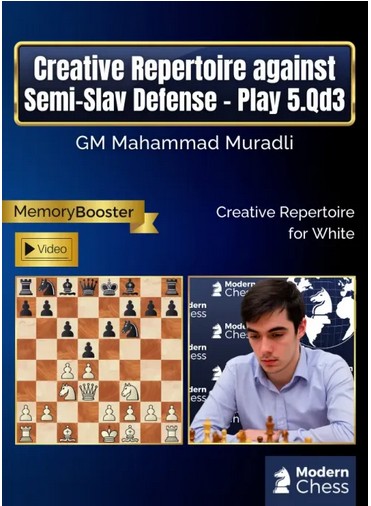
Creative Repertoire against Semi-Slav Defense – Play 5.Qd3 + PGN March 4, 2026
Original price was: $ 30.$ 4Current price is: $ 4.
OFF - 87%10000 in stock

Description
Reviews (0)
Description
| Category | PREMIUM CHESS VIDEO, Modern Chess |
|---|
Creative Repertoire against Semi-Slav Defense: Play 5.Qd3
The Unexplored Territory Strategy
When GM Mahammad Muradli presents 5.Qd3 against the Semi-Slav, he’s not offering another sideline for surprise value. He’s revealing a strategic weapon that elite grandmasters have quietly employed at the highest level—one that leads to positions where your opponent’s theoretical knowledge runs out precisely when yours begins. The course’s final chapter arrives at a position with zero database games, yet this isn’t the result of dubious play. It’s the natural consequence of a flexible, strategically sound system that steers the game into uncharted waters while maintaining concrete advantages throughout.
The early queen development to d3 challenges the fundamental assumption of Semi-Slav theory: that Black can comfortably transpose into well-known structures. Instead of allowing standard setups, White creates immediate tension around the c4-pawn, and depending on Black’s response, either builds long-term pressure in strategic positions or seizes central space with e4 at precisely the right moment. Muradli’s approach is particularly effective because it combines strategic flexibility with concrete preparation—his repertoire doesn’t rely on opponents making mistakes, but rather on understanding the character of resulting positions better than they do.
Course Structure and Novelties
The repertoire is built around meeting Black’s most critical tries with ambitious, relatively unexplored paths. After 1.d4 Nf6 2.c4 e6 3.Nf3 d5 4.Nc3 c6 5.Qd3, Muradli addresses every significant Black setup:

Variation Map:
- Chapter 1: Rare 5th move alternatives (5…b6 and others)
- Chapter 2: 5…Nbd7 6.e4! – immediate central strike
- Chapter 3: 5…dxc4 6.Qxc4 b5 7.Qd3 b4 and other 7th move deviations
- Chapters 4-5: The 7…a6 system with 8.a4! (39 games vs. 600+ in main lines)
- Chapter 4: 8…b4
- Chapter 5: 8…Bb7 9.e4!
- Chapter 6: 7…Nbd7 8.e4 b4 9.Na4
- Chapter 7: 8…a6 and alternatives after 7…Bb7 8.e4 b4
- Chapter 8: 9…Nbd7 10.Be3 – restraining …c5
- Chapter 9: Deviations in the main line before move 13
- Chapter 10: Critical tabiya after 13.Nd2 Nxd2 14.Bxd2 – zero database games
Reviews (0)
Leave a Reply
You also like

Calculation Workshop with FM Viktor Neustroev (MP4)
Original price was: $ 30.$ 4Current price is: $ 4. Quick ViewAdd to cart
Pawns on One Wing in the Endgame, GM Ioannis Papaioannou
Original price was: $ 30.$ 4Current price is: $ 4. Quick ViewAdd to cart
Beginner Mistakes and How to Avoid Them: The Middlegame – GM Josh Friedel
Original price was: $ 30.$ 4Current price is: $ 4. Quick ViewAdd to cart
Chessbase Play the Pirc like a Grandmaster Vol. 1: Positional lines CBFT
Original price was: $ 30.$ 4Current price is: $ 4. Quick ViewAdd to cart
IM Christof Sielecki 33 Chess Concepts that took down World Champions (MP4)
Original price was: $ 30.$ 4Current price is: $ 4. Quick ViewAdd to cart
7 The Paco Vallejo Method – GM Paco Vallejo
Original price was: $ 30.$ 4Current price is: $ 4. Quick ViewAdd to cart
BIG Chessbase Magazine Collection From CBM 01 – 213 SDVL (PGN & CBH Collection) 25 GB SI...
Original price was: $ 30.$ 4Current price is: $ 4. Quick ViewAdd to cart
The modern Grand Prix Attack – Trent SDVL & PGN
Original price was: $ 30.$ 4Current price is: $ 4. Quick ViewAdd to cart
Reviews
There are no reviews yet.