
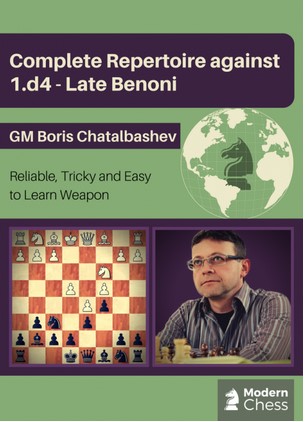
Complete Repertoire against 1.d4 – Late Benoni PGN Only
Original price was: $ 30.$ 4Current price is: $ 4.
OFF - 87%10000 in stock

Description
Reviews (0)
Description
| Category | CHESS DATABASE |
|---|
General overview
When bulding an opening repertoire many players (myself included) prefer slightly off-beat and rare variations. Especially when they do not have time to study the latest novelties in modern lines. As our opponent is expected not to have enough knowledge and experience in those rare openings, such an approach gives us some practical advantages. But what to choose? Most gambits do not have good reputation and rightly so. On the other hand rare openings like Classic Benoni, for example, are known to lead to a passive play.
To our readers I offer a variation that had served me well during many years, it is solid enough, but far from being passive. It has no official name, but in chess literature is often called “Reluctant Benoni” or “Late Benoni”. You should not be disturbed by the rather unimpressive name. Just try to achieve impressive results with it.
The main position arises after 1.d4 Nf6 2.c4 c5 3.d5 g6 4.Nc3 Bg7

This is the normal set-up and move order, though other move orders are also possible. It might depend what you expect from your opponent. If he likes to play 3.Nf3 aiming for transposition into English Opening, then even 1…c5 might be good move to start with. Also, 2.Nf3 g6 3.c4 c5 4.d5 is common enough, but here White has the option of going for Maroczy with 4.Nc3. Within the framework of the current database, different transpositions and move orderes are covered in detail.
On the diagram position, you can see the way in which Black develops his pieces in Late Benoni. In general, he goes for fianchetto, then d7-d6 and castles, leaving e7-e6 and eventual e6xd5 (sometimes it is even e6-e5) for last.
At this point, White’s only reasonable alternative to 5.e4 is 5.Nf3 followed by g2-g3 . In his repertoire book for 1.d4, the remarkable theoretician GM Boris Avrukh advocated this approach for White. Here my recommendation is:
5…d6 6.g3 0-0 7.Bg2 Na6 8.0-0 Nc7

With his last move Black is trying to prepare the advance b7-b5. Generally, at certain moment, White prevents Black from carrying out this typical break by means of a2-a4. As I have proved in my analysis to this structure, when white pawn is on “a4”, Black should consider closing the center by e7-e5. As you will find out in the database, the diagram position is not particularly dangerous for Black.
The critical position of the variation is reached after 5.e4 d6

This is very important position in which White has a variety of options. In the database, I examine the following moves:
6.f4, 6.f3, 6.Be2 followed by 7.Bg5, 6.Bd3 followed by 7.Nge2 and the main move 6.Nf3
1) White plays 6.f4

Four pawns’ attack is not as dangerous here, especially compared to Modern Benoni, where White has the possibility of early Bb5+.
After 6.f4 0-0 7.Nf3 e6 8.Be2 exd5 9.cxd5 , I recommend the rare 9…Nbd7

This original attempt is regularly used by Teimour Radjabov ( on the picture below ). According to my analysis, Black not only equalizes but in some cases, he can even overtake the initiative.
Reviews (0)
Leave a Reply
You also like

Powerbase 2020 – Petroff Defence
Original price was: $ 30.$ 4Current price is: $ 4. Quick ViewAdd to cart
Endgame study database HHdbVI The world’s largest collection of endgame studies, 93,839 endgame...
Original price was: $ 30.$ 4Current price is: $ 4. Quick ViewAdd to cart
CHESS DATABASE | Opening Encyclopaedia 2022
Original price was: $ 30.$ 4Current price is: $ 4. Quick ViewAdd to cart
Powerbase 2022 – French Defence
Original price was: $ 30.$ 4Current price is: $ 4. Quick ViewAdd to cart
Corr Database 2024 Correspondence Games from 1804 until 2023
Original price was: $ 30.$ 4Current price is: $ 4. Quick ViewAdd to cart
Powerbase 2022 – Sicilian Paulsen
Original price was: $ 30.$ 4Current price is: $ 4. Quick ViewAdd to cart
ChessBase Endgame Study Database 2000 CBV
Original price was: $ 30.$ 4Current price is: $ 4. Quick ViewAdd to cart

Reviews
There are no reviews yet.