
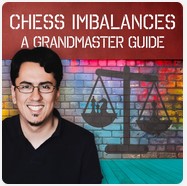
Chess Imbalances A Grandmaster Guide + PGN Nov 17, 2025
Original price was: $ 30.$ 4Current price is: $ 4.
OFF - 87%9999 in stock

Description
Reviews (0)
Description
| Category | PREMIUM CHESS VIDEO, Chessable |
|---|
Follow This Ph.D. Playbook on Finding
Your Edge — Even When Chess
Engines Show Triple-Zeroes!
Your opponent is a tough nut to crack. The position — dead even. But hidden in there is one line which gives you a serious chance of winning. How do you find it? You unbalance the pieces! Because when your pieces differ from theirs, you open up plans the other side can’t copy nor stop.
Did you end up with the two bishops against a bishop and knight?
Right away, you hold the upper hand in an opposite-side race to promotion.

Black’s knight is too far to assist their pawns, while
your bishops don’t even have to move to delay
the enemy advance AND support yours
Only have a rook against a bishop and knight?
That means you can attack their 7th or 8th rank in one swoop… while they maneuver for 2 or 3 moves before they can even threaten anything.

The rook can create threats faster than
the knight and bishop could coordinate
And when you’re fighting a queen with a bunch of light pieces?
You hit their weak pawns, weak squares, and even the opponent’s strongest piece… because they wouldn’t dare trade their 9 points for your 3 points.

Black attacks multiple targets while the
precious white queen must take cover
Don’t worry if it all seems advanced right now. You can learn how to unbalance the pieces, and turn those matchups into a decisive edge.
Enter Chess Imbalances: A Grandmaster Guide by Grandmaster Mauricio Flores Rios.
Flores Rios hit a peak FIDE rating of 2537 and held Chile’s #1 spot for years. He also carried his country’s flag in 3 Olympiads — beating 2700-rated opponents.
His best tournament win came at the 21st Montcada International Open. There, he finished clear 1st in a tough field with 21 GMs — some even ranked among the world’s top 100.
But Flores Rios didn’t stop at the board.
After earning the GM title, he pursued a Ph.D. in Applied Mathematics at the University of Minnesota. His specialty? Pattern recognition and learning algorithms.
These same skills are what drove him to spend over 9 years writing Chess Imbalances.
The result is a doctorate-level guide to…
Reviews (0)
Leave a Reply
You also like

The Elegant English – Part 2 Chessable
Original price was: $ 30.$ 4Current price is: $ 4. Quick ViewAdd to cart
3 The Lenderman Method 1 – GM Aleksandr Lenderman
Original price was: $ 30.$ 4Current price is: $ 4. Quick ViewAdd to cart
7 The Paco Vallejo Method – GM Paco Vallejo
Original price was: $ 30.$ 4Current price is: $ 4. Quick ViewAdd to cart
100 Repertoires: Four Knights Sicilian
Original price was: $ 30.$ 4Current price is: $ 4. Quick ViewAdd to cart
The modern Grand Prix Attack – Trent SDVL & PGN
Original price was: $ 30.$ 4Current price is: $ 4. Quick ViewAdd to cart
Calculation Workshop with FM Viktor Neustroev (MP4)
Original price was: $ 30.$ 4Current price is: $ 4. Quick ViewAdd to cart
Erwin’s Opening Lab : The Cozio Defense Chessable
Original price was: $ 30.$ 4Current price is: $ 4. Quick ViewAdd to cart
A Complete Najdorf Repertoire by IM Sopiko Guramishvili
Original price was: $ 30.$ 4Current price is: $ 4. Quick ViewAdd to cart
Reviews
There are no reviews yet.