
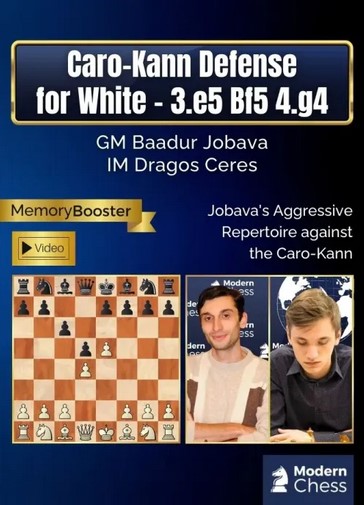
Caro-Kann Defense for White – 3.e5 Bf5 4.g4 + PGN November 21, 2025
Original price was: $ 30.$ 4Current price is: $ 4.
OFF - 87%10000 in stock

Description
Reviews (0)
Description
| Category | Modern Chess, PREMIUM CHESS VIDEO |
|---|
Jobava’s Fighting Answer to the Caro-Kann: The Aggressive 4.g4
When Mikhail Tal and Alexei Shirov attacked the Caro-Kann with 4.g4, they created unforgettable tactical fireworks. Then the engine era arrived, and conventional wisdom declared the line “harmless if Black knows the theory.” But what happens when you combine modern computer analysis with creative human intuition? GM Baadur Jobava and IM Dragos Ceres demonstrate that this aggressive system has been quietly revolutionized—particularly after Nepomniachtchi’s 2017 idea 6.e6, which changed the evaluation of the entire variation.
Why This Course Exists
The Caro-Kann’s reputation for solidity makes it a favorite among players who trust structure and deep positional understanding. This course offers White a completely different approach: unbalance the position early, create immediate tactical threats, and force opponents into unfamiliar territory. The statistics tell the story—Black’s main line 3…Bf5 appears in roughly 75% of Caro-Kann games, yet the critical position after 10.Ne2 has been reached in only 36 games. This gap between frequency and preparation creates genuine practical opportunities.
Jobava and Ceres bring complementary perspectives to the material. Jobava’s creative approach to opening preparation—familiar from his recent collaboration on Jobava’s Benoni Defense – Fight the Anti-Benoni Systems—meets Ceres’s systematic analytical method. The result is a repertoire that doesn’t just present moves, but explains the logic behind White’s aggressive plan and how to maintain practical pressure even in objectively balanced positions.
Variation Map
After 1.e4 c6 2.d4 d5 3.e5
Main Line: 3…Bf5 4.g4 (Chapters 1-6)
- 4…Bd7 — The Creative Caro-Kann approach (Chapter 1)
- 4…Bg6 — Immediate retreat, less precise (Chapter 2)
- 4…Be4 5.f3 Bg6 6.e6! — The modern mainline
- 6…Qd6 — Declining the pawn (Chapter 3)
- 6…fxe6 7.h4 h5 8.Bd3 Bxd3 9.Qxd3 Qd6 10.Ne2
- 10…e5 — Second critical response (Chapter 5)
- 10…Nd7 — Black’s most solid defense (Chapter 6)
- Critical position: 11.Qg6+ Kd8 12.Bg5 and 11.Bf4
Alternative System: 3…c5 (Chapters 7-10)
- 4.dxc5 e6 5.Be3 — The pawn-retention approach
- 4.dxc5 Nc6 — Popular sideline (Chapter 7)
- Various Black attempts to recover the c5-pawn (Chapters 8-10)
Course Structure
The repertoire is built around two distinct strategic concepts. Against 3…Bf5, White plays 4.g4 followed by the key idea 6.e6—a move that only gained serious attention after Nepomniachtchi-Shankland in 2017. The position after 10.Ne2 represents the critical battleground, where White has practical attacking chances despite limited theoretical exploration. Against 3…c5, the course recommends 4.dxc5 followed by 5.Be3, maintaining the extra pawn and making Black work to equalize.
Technical Details:
- 10 Chapters
- 30 test positions
- Memory Booster
- To Go Version of every chapter
- 3 hours and 10 minutes of video instruction
- Multilingual PGN availability (English, German, French, Spanish)
Who Should Study This Course
This repertoire suits players who prefer concrete tactical positions over long theoretical discussions. The 4.g4 system creates immediate imbalances and practical challenges, particularly effective in faster time controls where opponents must navigate unfamiliar complications. The limited existing theory means your preparation goes further—you’re not memorizing 25-move sequences, but understanding key positions and typical attacking patterns.
Reviews (0)
Leave a Reply
You also like

Every Gambit Refuted Opening course by GM Eugene Perelshteyn Chessable
Original price was: $ 30.$ 4Current price is: $ 4. Quick ViewAdd to cart
Calculation Workshop with FM Viktor Neustroev (MP4)
Original price was: $ 30.$ 4Current price is: $ 4. Quick ViewAdd to cart
How to Find Positional Chess Sacrifices with IM Asaf Givon
Original price was: $ 30.$ 4Current price is: $ 4. Quick ViewAdd to cart
IM Christof Sielecki 33 Chess Concepts that took down World Champions (MP4)
Original price was: $ 30.$ 4Current price is: $ 4. Quick ViewAdd to cart
The Elegant English – Part 2 Chessable
Original price was: $ 30.$ 4Current price is: $ 4. Quick ViewAdd to cart
3 The Lenderman Method 1 – GM Aleksandr Lenderman
Original price was: $ 30.$ 4Current price is: $ 4. Quick ViewAdd to cart
Pawns on One Wing in the Endgame, GM Ioannis Papaioannou
Original price was: $ 30.$ 4Current price is: $ 4. Quick ViewAdd to cart
Beginner Mistakes and How to Avoid Them: The Middlegame – GM Josh Friedel
Original price was: $ 30.$ 4Current price is: $ 4. Quick ViewAdd to cart
Reviews
There are no reviews yet.