
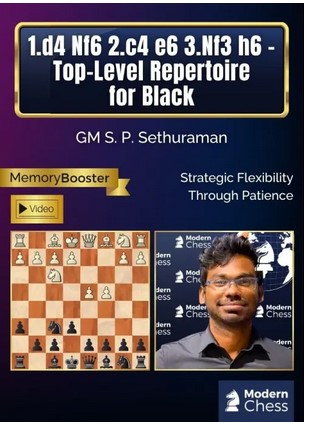
1.d4 Nf6 2.c4 e6 3.Nf3 h6 – Top-Lev Repertoire for Black GM S.P Sethuraman July 22, 2025
Original price was: $ 30.$ 4Current price is: $ 4.
OFF - 87%9997 in stock

Description
Reviews (0)
Description
| Category | Modern Chess, PREMIUM CHESS VIDEO |
|---|
The Modern 3…h6 Repertoire: A Strategic Weapon for the Tournament Player
GM S.P. Sethuraman introduces a flexible and practical approach to meeting 1.d4 that’s gaining traction at the highest levels of competitive chess.
In the ever-evolving landscape of chess theory, finding fresh approaches to well-established openings has become increasingly valuable. GM S.P. Sethuraman’s latest course for Modern Chess introduces players to a sophisticated repertoire built around the seemingly modest move 3…h6 in the Queen’s Indian setup.
The starting position of our repertoire arises after the moves 1.d4 Nf6 2.c4 e6 3.Nf3 h6

The Rise of 3…h6: From Curiosity to Championship Weapon
What makes a quiet pawn move worthy of serious study? The answer lies in understanding modern chess preparation and the psychological demands of high-level competition. GM Sethuraman first encountered this approach during a live game between World Champion D. Gukesh and Parham Maghsoodloo in the Turkish League 2022, where the move’s strategic depth became immediately apparent.
Following that encounter, Gukesh began incorporating 1.d4 Nf6 2.c4 e6 3.Nf3 h6 into his own repertoire with remarkable success. The approach has since attracted other elite grandmasters including Fedoseev, Tabatabaei, Murzin, and Alekseenko, validating its soundness at the highest competitive levels.
Strategic Philosophy: Flexibility Over Memorization
The essence of the 3…h6 system lies in its philosophical approach to opening preparation. Rather than committing immediately to a specific pawn structure with moves like 3…d5, Black adopts a waiting strategy that preserves maximum flexibility.
This approach addresses a growing concern among strong players: the increasing importance of engine preparation in theoretical battles. By choosing 3…h6, Black sidesteps the heavily analyzed main lines of the Queen’s Gambit Declined and Nimzo-Indian Defense while maintaining all the strategic options these openings offer.
Key Strategic Concepts
Structural Flexibility: Black retains the option to transpose into favorable versions of established systems, including the Nimzo-Indian (with …Bb4), Queen’s Indian structures, or Semi-Slav formations, depending on White’s setup.
Theoretical Avoidance: The move steers clear of White’s most prepared lines while maintaining sound positional foundations—a crucial advantage in practical play.
Dynamic Potential: Black preserves multiple pawn breaks (…c5, …d5, …e5) and piece development schemes, allowing for adaptive play based on White’s commitments.
Comprehensive Course Structure
GM Sethuraman’s systematic treatment includes:
- 5 Theoretical Chapters: Covering all major White responses and key transpositions
- 5 Model Games: Demonstrating practical implementation by strong grandmasters
- 11 Interactive Test Positions: Reinforcing critical concepts and tactical motifs
- Memory Booster: Streamlined preparation system for efficient retention
- 3 hours 14 minutes of Video Content: In-depth analysis and explanation
Who Benefits from This Repertoire?
This system particularly appeals to players who:
- Seek practical winning chances without relying on extensive theoretical memorization
- Prefer strategic complexity over sharp tactical battles in the opening
- Want to avoid their opponents’ preparation while maintaining objective equality
- Appreciate flexible systems that adapt to different playing styles
The repertoire’s strength lies not in promising easy victories, but in providing a sound, flexible foundation that allows stronger players to outplay their opponents through superior understanding rather than theoretical advantage.
Modern Chess Philosophy in Action
This course exemplifies Modern Chess’s commitment to practical, high-quality chess education. Rather than presenting 3…h6 as a revolutionary breakthrough, GM Sethuraman treats it as what it is: a sophisticated tool for experienced players seeking fresh approaches to familiar positions.
The analysis respects the high level of Modern Chess audience, providing deep strategic insights without oversimplification. Each variation is examined with the precision that strong players expect, while maintaining focus on practical applicability.
Technical Excellence and Practical Application
GM Sethuraman’s treatment demonstrates why this repertoire has gained acceptance among elite players. The course material includes detailed analysis of critical positions, clear explanation of strategic themes, and practical guidance for handling transpositions.
The systematic approach ensures that students understand not just the moves, but the underlying strategic principles that make this system effective. This depth of preparation allows confident implementation in serious competitive play.
Reviews (0)
Leave a Reply
You also like

Queen’s Gambit Accepted – Simple Solution to 1.d4 by GM Grigor Grigorov, GM Petar G. Ar...
Original price was: $ 30.$ 4Current price is: $ 4. Quick ViewAdd to cart
30 Fundamental Classical Games with GM Renato Quintillano
Original price was: $ 30.$ 4Current price is: $ 4. Quick ViewAdd to cart
IM Christof Sielecki 33 Chess Concepts that took down World Champions (MP4)
Original price was: $ 30.$ 4Current price is: $ 4. Quick ViewAdd to cart
Killer Instinct Conversion in the Endgame
Original price was: $ 30.$ 4Current price is: $ 4. Quick ViewAdd to cart
Chess Strategy and Tactics Mikhail Tal’s Amazing Games by Tryfon Gavriel (MP4)
Original price was: $ 30.$ 4Current price is: $ 4. Quick ViewAdd to cart
A World Champion’s Repertoire against the Queen’s Gambit Declined by Robert Ris (MP4)
Original price was: $ 30.$ 4Current price is: $ 4. Quick ViewAdd to cart
Lifetime Repertoires The Nimzo-Ragozin – Sielecki Chessable
Original price was: $ 30.$ 4Current price is: $ 4. Quick ViewAdd to cart
Beginner Mistakes and How to Avoid Them: The Middlegame – GM Josh Friedel
Original price was: $ 30.$ 4Current price is: $ 4. Quick ViewAdd to cart
Reviews
There are no reviews yet.